

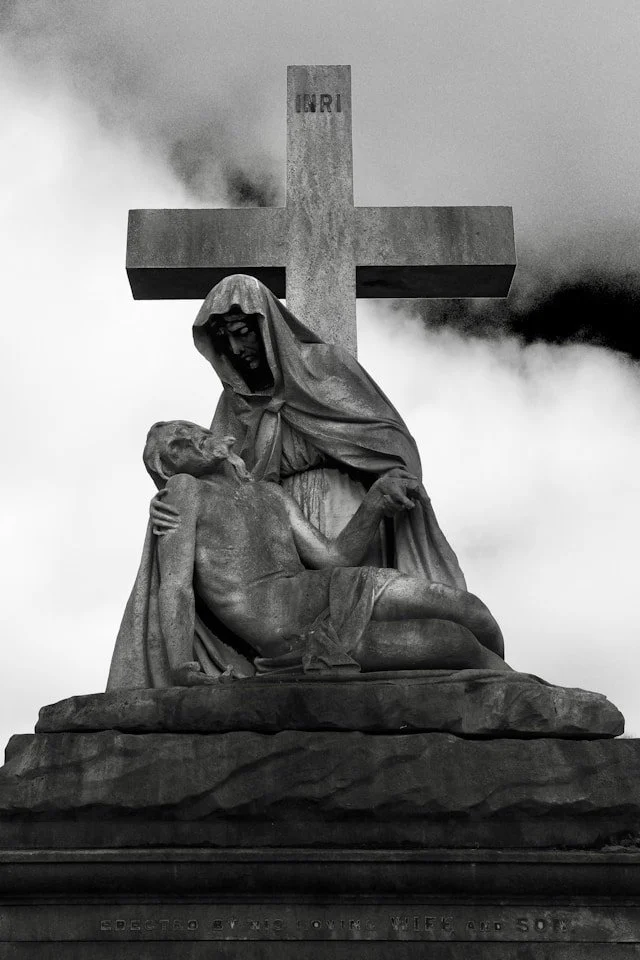



“The end is near!” “Repent!”
Have you ever seen a statement of prophetic warning spray-painted on a wall or in a subway station? got to be honest, I don’t take much notice to such warnings. But what if those warnings were for me and for you?
Who respects the body more? Christians or the world? I bet most Americans would answer that the world loves the body more than Christians do. After all, the world celebrates its sexuality and supports going after whatever our body desires. Many will judge their Valentine’s Day on whether it was a day they got what they desired.
Ours is an age of affirmation, and our bodies appear to be the object of that unquestioned affirmation.
But what if it isn’t true that our world truly values our bodies? What would it mean for issues such as gender and abortion if the Christian ethic is actually the worldview that honors the body most deeply?
The reality behind our culture’s favorite mantra: Matthew McCullough begins, “I don’t know where it came from, but now it seems to be everywhere. I hear it on podcasts and TV shows. I’ve seen it on T-shirts and social media graphics. A quick search for it on Amazon brings up hundreds of results, ranging from books for kids and adults to silver charm bracelets to hoodies of many colors to embroidered makeup cases to wall hangings and throw pillows and stickers to place on your rearview mirror. I’m talking about the simple, uplifting mantra for our times: ‘You Are Enough.’”
Jesus wept (Jn. 11:35).
This is the shortest verse in the Bible.
It is profound as it applies to the heart of Our Lord, Jesus Christ; to those whom he came to save: You. Me. Us.
There is much pain and confusion in our world today. You don't need to look far to see it. Some of us have been brought to our knees in grief and in this moment cannot hardly see past it; the same can be said of those of us in the throes of financial woe; relational strife; physical affliction.
Hopelessness. Dread. Despair.
When peace feels impossible: Christopher Cook says, “As such, when Paul says “do not be anxious,” he is not instructing believers to numb their emotions, detach from their circumstances, or pretend life doesn’t hurt. He’s inviting us to recalibrate the affections of our hearts. And that recalibration begins with a theological claim far deeper than a surface-level command. It begins with presence.”
When waiting draws us near: Bethany Broderick says, “Our world seems allergic to waiting. We pay hundreds of dollars for faster shipping
“We won!” If you’re a sports fan, you might have bellowed those words when your favorite team emerged victorious from an epic showdown.
But of course, we know that we didn’t win at all. I sat on my couch and cheered for my Chiefs. But it was Andy Reid who drew up the play, Patrick Maholmes who threw the pass, and Travis Kelce who caught it.
They, not we, won.
Many of us have come to believe the opposite lie regarding the church. It’s easy to think they are doing the work of the gospel. In a celebrity culture, it’s easy to get sucked into thinking that pastors do ministry and preachers do gospel work.
We are feeling all the feels. Our youngest, Soren, is about to graduate from high school. This has been a season of reflection for Angel and me and a season of preparation. In our children’s ministry hallways at New Life next to each age level we have containers that represent how many days of influence remain for you as a parent before your child launches. I recognize, of course, that there is no finish line for parenting, but one’s influence and role changes significantly in each season.
As we look back on our parenting, the most important things we taught our children were who God is and who they were.
Who would I be if I was happy? Trevin Wax warns us, “Many young people are increasingly drawn to establishing and expressing their identities through their psychological maladies.”
Wherever he leads, I’ll go: Glenna Marshall shares a story I bet you might identify with, “In young, untried faith, I nearly invited him to test me, telling him in a long, journaled prayer that wherever he led, I would most certainly go. I banked on my obedience. I would be stalwart, no matter what came. But life came. And the Lord led me to places I longed to escape from: decades of infertility, disease, chronic pain that battered my body for years on end.”
Intrusive thoughts are unwelcome and hard to control. I can remember having intrusive thoughts from the time I was a child. When we drove, I often felt the compulsion to press one foot down on the floor between the telephone poles (and yes, I also hopped over the cracks in the sidewalk). At other times, when walking alone, I remember the persistent thought, “He’s watching you.” I would search the bushes and trees for the one my mind told me was watching me.
The aged prophet Isaiah showed up at the bedside of the middle-aged king. Hezekiah was only about 39 years old and terminally ill. But the prophet was not bringing good news, “Set your house in order, for you shall die, you shall not recover” (Is. 38:1).
The weak king cried out to God, “’ Please, O LORD, remember how I have walked before you in faithfulness and with a whole heart, and have done what is good in your sight’. And Hezekiah wept bitterly.” (Is. 38:3).
Britain’s loneliest sheep: Stephen Steele begins, “A high-profile new resident arrived in South West Scotland recently – a ewe once known as ‘Britain’s Loneliest Sheep’. Fiona, as she has been named, was rescued after being stranded for more than two years at the foot of cliffs in the Scottish Highlands.”
When the walk becomes a crawl: David Powlison exhorts us, “The key to getting a long view of sanctification is to understand direction. What matters most is not the distance you’ve covered. It’s not the speed you’re going. It’s not how long you’ve been a Christian. It’s the direction you’re heading.”
“We are currently experiencing the largest and fastest religious shift in US history. It is greater than the First and Second Great Awakening and every revival in our country combined...but in the opposite direction.” This is the conclusion of the largest and most comprehensive study of dechurching in America by sociologists Ryan Burge and Paul Djupe. In The Great DeChurching, pastors Jim Davis and Michael Graham unpack why and how over the past twenty-five years, forty million of those who formerly attended church no longer do so.
Jerusalem, Israel
3:15 am, April 13
I sat up in bed to a wailing sound I had never heard before, but knew immediately: an air raid siren. Our building rattled to the booms of interceptors from Israel’s missile defense system hitting their inbound targets. I pulled back the curtains and watched as sprays of light streaked the sky.
Iran launched 170 drones, 20 cruise missiles, and 120 ballistic missiles at Israel in retaliation for Israel’s purported attack on an Iranian embassy in Syria.
Why I’m not an exvangelical: Carey Nieuwhof explains, “I, too, am tired of the abuse, corruption, arrogance, shallow thinking, anti-intellectualism, partisanship, and politicization of the Christian message. I’m done with the racism, toxic culture, and the abuse of power we see again and again.”
What do Mormons believe about marriage? Liesl Counterman explains, “In Mormonism, the bare minimum entrance requirement to eternal life is baptism, but the way to reach the highest heaven is through marriage.”
Nothing is more iconic to the Tucson landscape than the saguaro. The emblematic cactus is to the Sonoran Desert what the palm tree is to Miami: hard to imagine without it. Saguaros typically live between one hundred and fifty to one hundred and seventy-five years, not sprouting its trademark arms until around thirty to seventy years of its life and growing to around fifty feet tall.
For those Sonoran Desert natives, we intuitively know where saguaros thrive. They love the rocky (both granite and volcanic) soil at the foothills of the five beautiful mountain ranges that surround Tucson.
Sign up to get The Bee Hive delivered to your inbox and receive a free 50 Books That Changed My Life (and Might Change Yours, Too) download!