I really dislike horror movies. I’ve only seen a handful in my life, and I’ve never enjoyed the experience. But the American public gobbles them up. I remember a time when horror movies only came out around Halloween; now it seems there isn’t a time of year when at least one horror movie isn't playing in theaters.
Experts have researched what the draw of horror movies is. They call the experience “recreational fear”: the ability to navigate fear in a safe environment. The audience experiences an adrenaline rush of danger, and then the sweet relief of escape. Horror movies can provide an emotional release for anxiety, stress, or grief.
In an anxious generation, maybe horror movie watchers are onto something. As we’ve been preaching through the book of Revelation at New Life, it has struck me how similar John’s apocalyptic vision is to a horror movie. In no place is that truer than the heart of the book, chapters 6-16.
The sevens
John writes to seven churches in Asia Minor that fear the oppressive hand of Rome. John’s letter to the churches offers glimpses of the horrors of wrath Christ will bring upon those who reject him, interspersed with glimpses of Christ's glory.
John layers three sets of seven judgments as the primary scenes of the horror movie that unfolds. The scenes escalate in severity and horror, warning of the devastation that occurs when people reject God while simultaneously highlighting God’s sovereignty over history. Among those whom John critiques in his apocalyptic letter is the Roman government. To get the letter past the Roman guards, John layers it with Hebraic imagery and symbolism.
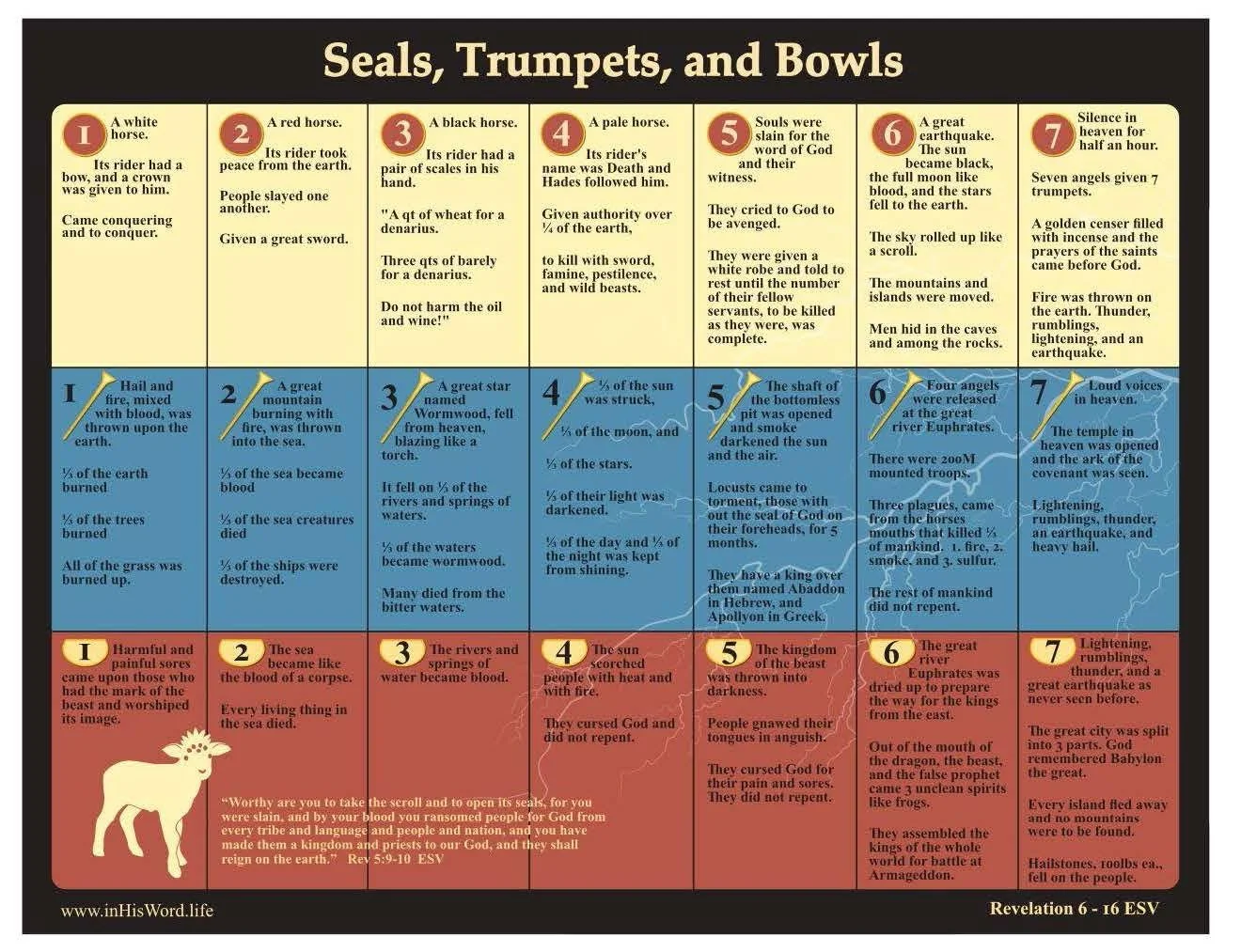
Below is a graphic from inhisword.life that gives an overview of the seven seals, trumpets, and bowls. Note that the first four of each of the sevens are distinct from the final three. The first four seals are the four horsemen, followed by the three woes. The first four trumpets and bowls navigate the four classifications of the earth: ground, sea, river, and sky, and then three spiritual judgments. The sophistication of John’s writing is jaw-dropping. Three (relating to God), four (relating to the earth), and seven (relating to time) are all numbers of completion. By this symbolic organization, John triply emphasizes God’s completed work. Through the Spirit's inspiration, John has created a perfect literary gem, flawless from every angle.
The Seven Seals:
First Seal - The White Horse: Rev 6:1-2
Second Seal - The Red Horse: Rev. 6:3-4
Third Seal - The Black Horse: Rev. 6:5
Fourth Seal - The Pale Horse: Rev. 6:7-8
Fifth Seal - The Martyrs: Rev. 6:9-10
Sixth Seal - Cosmic Disturbances: Rev. 6:12-17
Seventh Seal - Silence: Rev. 8:1
The seals are on the scroll that is found in the hands of God the Father (Rev. 5:1) that only the Lamb can open (Rev. 5:9). The scroll is written by the hand of the King of Kings, reminding us that he has written eternity. Nothing is out of control. The seven seals are opened with the four horses bringing judgment, war, famine, and death. The three woes follow: a cry of justice from the martyrs, the great day of God’s wrath, and silence.
The Seven Trumpets
• First Trumpet: one third of the earth is destroyed (Rev. 8:7).
• Second Trumpet: A burning mountain falls into the sea, turning a third of the sea to blood, killing marine life and destroying ships (Rev. 8:8-9).
• Third Trumpet: A great star falls, bittering a third of the waters (Rev. 8:10-11).
• Fourth Trumpet: A third of the sun, moon, and stars are darkened (Rev. 8:12).
• Fifth Trumpet (First Woe): Satan wreaks havoc (Rev. 9:1-2, 5-6, 11).
• Sixth Trumpet (Second Woe): Four angels bound at the Euphrates unleash forces that kill a third of mankind (Rev. 9:13-15, 20-21).
• Seventh Trumpet (Third Woe): a call to worship (Rev. 11:15).
The seven trumpets follow. The trumpets are a declaration of warning. In the Old Testament, trumpets often signaled warnings or summoned people. Here they ring loud with the message: Return and repent before the final consummation. Note the echoes of the plagues in the trumpets (they will recur in the bowls as well). Just as the plagues in Exodus targeted Egyptian deities, these trumpet judgments target humanity’s false securities and point to God’s absolute supremacy. The first four strike the earth: the ground, the sea, the waters, and the sky. The final three are in the spiritual realm.
The Seven Bowls
• First Bowl: Malignant sores afflict those who bear the mark of the beast (Rev. 16:1-2).
• Second Bowl: The sea becomes like blood, and every living thing in the sea dies (Rev. 16:3).
• Third Bowl: Rivers and springs turn to blood (Rev. 16:4).
• Fourth Bowl: People are scorched with fierce heat from the sun (Rev. 16:8-9).
• Fifth Bowl: Darkness and pain fall upon the kingdom of the beast (Rev. 16:10-11).
• Sixth Bowl: The Euphrates dries up, making way for the kings of the east and the final conflict (Rev. 16:12-13, 15-16).
• Seventh Bowl: A loud voice from the throne proclaims, “It is done!” and a great earthquake and hailstorm ravage the earth (Rev. 16:17-21).
In the Bible, bowls represent wrath that is poured out. Here, the wrath of God against rebellion culminates in these seven bowls. The first four are poured out on the four parts of the earth: sores on people, the sea turned into blood, the rivers turned into blood, and the sun scorching people. The final three are in the spiritual realm: the kingdom of the beast, Armageddon prepared, and a declaration from the throne.
What is clear about the three sets of seven judgments? Today is the day we are called to repent. When tragedy strikes, turn to the Lord in repentance. No greater tragedy can befall us than standing against him. God will bring judgment. There is nothing this world can throw against you that God is not bigger than.
Two options: consecutive or recapitulating?
Are these describing one long timeline where the events happen one after another? Or are they describing the same set of judgments in three different ways? Have these seals, trumpets, and bowls happened already? Are they happening now? Or are they to come?
Futurist:
The futurist argues that these events are in the future and happen consecutively. There are some legitimate arguments for this interpretation. For instance, the judgments don’t perfectly square, especially the seals compared to the trumpets and bowls. For instance, consider the second seal: war; second trumpet: the sea becomes blood; and the second bowl: the sea becomes blood. The latter two mirror each other, but the seal is different.
In addition, the futurist points out that the numbers don’t line up across the judgments. In the seal judgments, 1/4 of the population dies (6:8), but in the trumpet judgments, 1/3 of the population dies (9:15).
Partially Fulfilled:
Another option is to see the events as partially fulfilled. This camp points out that for the futurist there are no practical implications for the 7 churches the letter was written to, and perhaps even us.
This camp points out that the seal, trumpet, and bowl judgments all end their descriptions in the end of the age (6:12-14; 11:15,18; 16:17,20). All judgments conclude with the judgment of those who don’t believe, with a vindication of believers, and the final complete inbreaking of God’s kingdom. These are final and one-time events, but they repeat three times.
This camp also takes us to Jesus’ similar prophetic word about the last day in Matthew 24, which focuses on the destruction of the temple, which happened in 70 AD. For these reasons, I believe the partial-fulfillment camp is the strongest. Jesus and John lay out “the last day of the Lord,” which has been the ongoing reality of Christians since Pentecost.
The peace of judgment
Why would John tell his already fearful audience of such terrors? How can horror bring hope? To a group facing possible imprisonment, pressure to recant their faith, exile, and brutal execution in the gladiatorial arena, John shows them that these horrors pale in light of God’s wrath.
John is encouraging those who have ears to hear, that there is a fear that casts out all other fear. The author of Proverbs says,
“The fear of the Lord is the beginning of wisdom,
and the knowledge of the Holy One is insight” (Prov. 9:10).
The fear of the Lord is unlike any other fear. We often fear things in this world because they are untrustworthy, unpredictable, cruel, arrogant, vindictive, or cold. God is none of these things. He is perfectly trustworthy, true, kind, humble, patience, and gracious toward us. The fear of the Lord is the twin of the worship of the Lord. God alone is worthy of our worship because he is our Creator, our Savior, and our Judge. Unlike human beings, we fear God because he is so good, so holy, so true. And John reminds us that “perfect love casts out fear” (1 Jn. 4:18).
We long for a day in which our tears are dried and all fears are gone. John promises us that day will come (Rev. 21:4), but it comes only when the Messiah has brought to an end all evil which opposes his reign. As Paul says, “He must reign until he has put all his enemies under his feet” (1 Cor. 15:25).
How did Jesus “put all his enemies under his feet”? How does he deliver us from the wrath to come (1 Thess. 1:10)? By drinking the cup (Mk. 14:36), becoming sin (2 Cor. 5:21), becoming cursed (Gal. 3:13), and taking the wrath of God on himself (Rms 3:24-25).
A pastor once shared about his encounter with a friend who worked for many years with survivors of sexual abuse. “Day after day she heard stories of evil and appalling injustice. I asked her how she managed not to become bitter and hard. She smiled very sweetly and said something that surprised me: “Oh, I look forward to judgment! It’s such a comfort to me that Jesus won’t allow all this evil to prevail forever. I’m reassured by the fact that all the injustices will be dealt with fairly and fully.”[i]
This is at the heart of John’s apocalypse: that the wrath of God heals the horror of the injustice and suffering of this world. Why would John tell his children horror stories? Because perfect fear casts out fear.
You May Also Appreciate:
LeBron James Messed Up Your Christianity
[i] Pete Greig, Lectio 365, August 25, 2026, https://lectio365.com.
Photo by Jon Butterworth on Unsplash