What kind of immortality do you dream of?
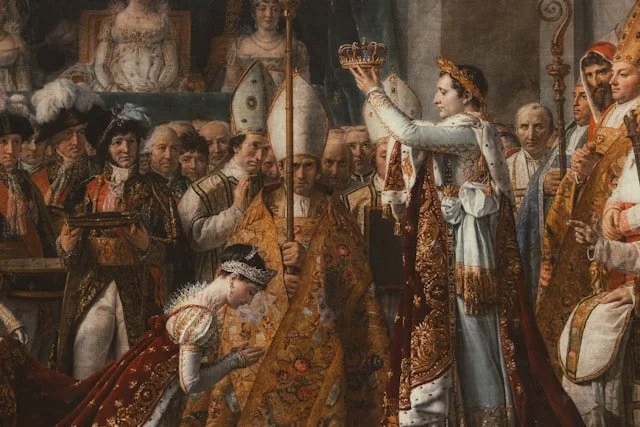
At just 19 years old, an ambitious commissioned officer of the French Royal Army faced a life-defining moment. As a revolution swept through France, would he support the people or the monarchy? His decision was based, as many would be throughout his life, more on strategy than belief. Which side would further his ambitions? As he would many times in his life, Napoleon Bonaparte backed the right side. Seven years later, Napoleon was commander of the French forces. He led an ambitious military campaign against the Austrians and their allies. His successes raised him to national prominence. He was hailed as a national hero. Three years later, unsatisfied with mere military power, Napoleon seized power in a coup d’etat, becoming First Consul. On December 2, 1804, the man who had begun his career by overthrowing the monarchy crowned himself emperor.
Napoleon was not a religious man. He was motivated by power, glory, and lasting fame. He is said to have said on several occasions, “There is no immortality, but the memory that is left in the minds of men.” Napoleon achieved his dream.
God also longs that we would be immortal, but not merely in the memory of those we know. He longs for us to experience eternal life with him.
Born that man no more may die
This Christmas season, we have been considering John Wesley’s brilliant hymn Hark! The Herald Angels Sing. Today, we conclude our reflection on this hymn by considering scripture’s audacious claim about Jesus: that he can give us eternal life. The carol concludes, “born that we no more may die, born to raise us from the earth,
born to give us second birth.”
Here are the lyrics of the hymn:
Hark! the herald angels sing,
“Glory to the newborn King:
peace on earth, and mercy mild,
God and sinners reconciled!”
Joyful, all ye nations, rise,
join the triumph of the skies;
with th’angelic hosts proclaim,
“Christ is born in Bethlehem!”
Refrain:
Hark! the herald angels sing,
“Glory to the newborn King”
Christ, by highest heaven adored,
Christ, the everlasting Lord,
late in time behold him come,
offspring of the Virgin’s womb:
veiled in flesh the Godhead see;
hail th’incarnate Deity,
pleased with us in flesh to dwell,
Jesus, our Immanuel.
Hail the heaven-born Prince of Peace!
Hail the Sun of Righteousness!
Light and life to all he brings,
risen with healing in his wings.
Mild he lays his glory by,
born that we no more may die,
born to raise us from the earth,
born to give us second birth.
What kind of life?
Throughout John’s gospel, Jesus emphasizes that he comes to bring eternal life. When Jesus is interacting with Nicodemus, Jesus emphasizes this point twice with the Jewish leader,
13 No one has ascended into heaven except he who descended from heaven, the Son of Man. 14 And as Moses lifted up the serpent in the wilderness, so must the Son of Man be lifted up, 15 that whoever believes in him may have eternal life. 16 “For God so loved the world, that he gave his only Son, that whoever believes in him should not perish but have eternal life. (John 3:13-16)
Jesus urges Nicodemus that the ultimate object of his belief is not the law, but himself. And what is the outcome of believing in Jesus? Eternal life. Seventeen times in his gospel John uses the phrase “eternal life” (it appears eight times in the other gospel accounts). In Greek the phrase is zōē aiōnios. What is clear is that John (and Jesus) are not merely referring to the length of one’s life. Jesus makes it clear that this eternal life is life lived in union with him, the source of life. Eternal life is life lived in participation with God: listening to him, knowing him, following him, and experiencing him. In other words, eternal life refers to the quality of life that begins in this life, not just after death. Consider Jesus’ succinct saying about eternal life to the disciples, “And this is eternal life, that they know you, the only true God, and Jesus Christ whom you have sent” (Jn 17:3).
Born to raise the sons of earth
When Lazarus dies, Martha meets Jesus, crushed that Jesus allowed her brother to die. “Jesus said to her, “I am the resurrection and the life. Whoever believes in me, though he die, yet shall he live, and everyone who lives and believes in me shall never die. Do you believe this?” (Jn 11:25-26). Eternal life, while far more than experiencing life forever, is not less than that.
Paul affirms Christ’s promise, “But in fact Christ has been raised from the dead, the firstfruits of those who have fallen asleep. For as by a man came death, by a man has come also the resurrection of the dead. For as in Adam all die, so also in Christ shall all be made alive” (1 Cor 15:20-22).
The birth of Jesus transforms the quality and the length of our lives. Are you fearful of sickness and aging? Are you tired of life shackled to this broken world? Christ is born! The angels declare the glory of Heaven’s newborn King who came to earth that we might experience the eternal now.
Mild he lays his glory by,
born that we no more may die,
born to raise us from the earth,
born to give us second birth.